I started noticing the shift when AI tools began answering “best tool for…” questions with confident shortlists instead of sending people through ten search results. For brands, that creates a strange new problem: you might rank well on Google, yet still be missing from the AI-generated answer your buyer actually reads.
That is where Peec AI search tracking becomes useful. It helps teams monitor how their brand appears in AI answers, compare that visibility against competitors, and turn messy AI search analytics into something they can act on.
The evolving landscape of brand visibility in AI answers
People no longer discover brands only through blue links, review pages, and comparison posts. More often, they ask ChatGPT, Perplexity, Gemini, or AI-powered search engines for a direct recommendation.
That changes the visibility game.
A traditional SEO tool can show rankings, keywords, and traffic. Useful, yes. But it usually cannot show whether an AI answer mentions your brand, ignores it, describes it accurately, or recommends a competitor instead. That gap is exactly where AI answer visibility starts to matter.
For a broader view of this shift, I’d still connect this workflow back to tracking brand visibility in AI search before choosing any tool.
How Peec AI search tracking addresses the challenge
Peec AI is built for one specific job: helping brands understand how they appear inside AI-generated answers. Instead of treating visibility as a search results page problem, it focuses on the answer layer itself.
That small distinction matters.
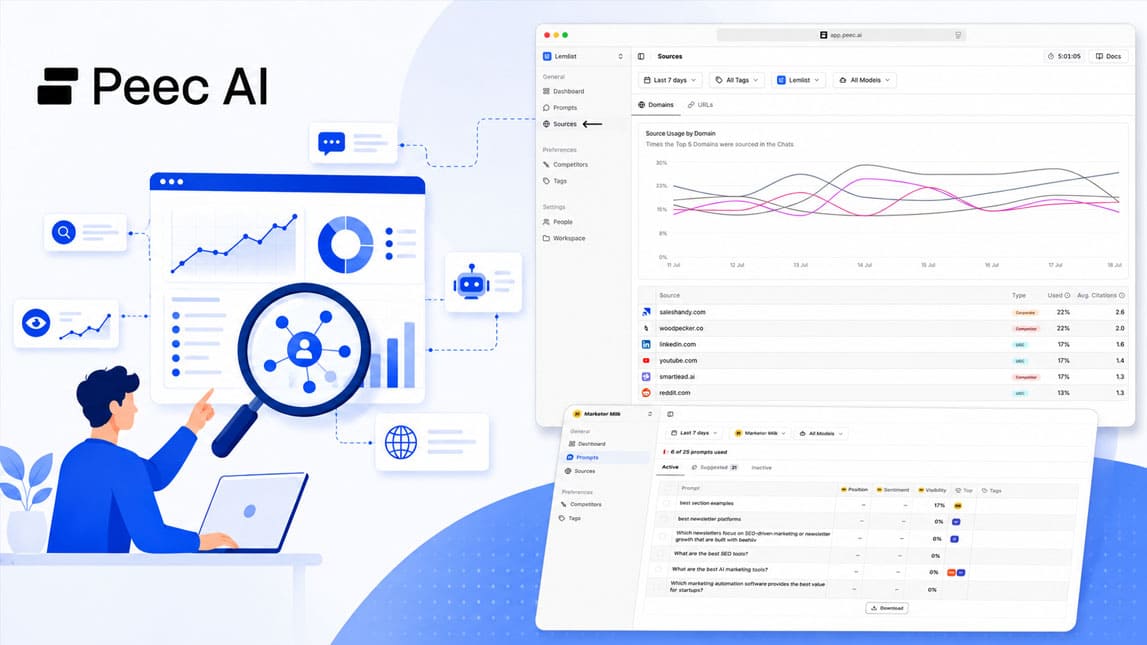
With Peec AI search tracking, you can monitor prompts, topics, competitors, and brand mentions across AI answer environments. A SaaS founder might check whether their product appears when someone asks for “best AI customer support tools.” A marketer might track whether their agency is mentioned around local SEO, paid ads, or automation workflows.
The value is not just knowing “we appeared.” It is knowing how you appeared, next to whom, and in what context.
You can explore the tool directly through Peec AI search tracking if AI answer visibility is becoming part of your growth stack.
Core features of Peec AI for AI answer visibility
What the data helps you see
The practical strength of Peec AI is that it turns vague AI visibility into something you can review regularly. Instead of manually testing prompts whenever you remember, you get a clearer pattern of how your brand shows up over time.
Its AI search analytics can help you monitor signals like:
- Brand mentions inside AI-generated answers.
- Competitor visibility for the same prompts.
- Sentiment or framing around your brand.
- Topics where your brand is missing.
- Changes in answer visibility over time.
Here is a simple way to frame the use case:
| Signal | Why it matters |
|---|---|
| Brand mention | Measures AI visibility. |
| Competitor mention | Shows market comparison. |
| Answer framing | Reveals perception gaps. |
| Topic coverage | Highlights content opportunities. |
This becomes especially useful when SEO traffic looks stable, but AI tools are already shaping buying decisions before users visit your site.
Practical workflow: Setting up your Peec AI tracking
A focused setup path
I would start small rather than tracking every possible keyword. Pick the prompts that influence buying decisions, comparisons, and brand trust.
A simple setup flow could look like this:
- Add your brand name and main competitors.
- Define core prompts your buyers might ask.
- Group prompts by product category, use case, or funnel stage.
- Review where your brand appears, disappears, or gets misrepresented.
- Turn visibility gaps into content, PR, or positioning actions.
This keeps Peec AI from becoming another dashboard you open once and forget. The goal is to create a repeatable brand tracking in AI search workflow, then connect it to your content roadmap. For the bigger strategy behind that, AI search optimization for brands is the natural next layer.
Harnessing GEO analytics for localized brand insights
AI answers are not always universal. A brand might appear strongly in one region, then barely show up in another. That matters if you sell internationally, serve local markets, or create region-specific content.
Peec AI’s GEO analytics can help you see how visibility changes by location and language. A tool recommended in the United States may not surface the same way in France, Canada, or Morocco. For local agencies, SaaS teams, and niche service providers, this can reveal where the brand is already trusted and where the content footprint feels thin.
That kind of regional detail makes optimization less random.
Why Peec AI is indispensable for your brand’s AI strategy
Peec AI is not just another reporting tool. Its real value is helping you notice what buyers may already be seeing before they reach your website.
For teams investing in AI search, GEO analytics, and content visibility, Peec AI gives a practical feedback layer. You can spot weak prompts, compare competitors, and adjust your content with more confidence.
AI search is still messy, uneven, and sometimes frustrating to measure. That is exactly why tools like Peec AI matter: they give brands a clearer way to see where they stand before AI answers become an even bigger part of the buying journey.
For freelancers, marketers, and SaaS teams, the practical move is not to chase every prompt. It is to track the answers that shape trust, spot the gaps early, and keep improving how your brand shows up when people ask AI for recommendations.

Artificial Intelligence Specialist | AI-Driven Workflow Strategist