
I tested a few AI search prompts for a brand recently, and the results were a little uncomfortable. The product had solid content, good SEO foundations, and happy customers, yet AI answers barely mentioned it. When it did appear, the description felt outdated, almost like the model had read the website two years ago and never came back.
That is why AI search visibility tracking matters. It helps you see how tools like ChatGPT, Perplexity, Gemini, and AI Overviews understand your brand before potential customers rely on those answers. For freelancers, SaaS builders, marketers, and indie makers, this is becoming less of a “nice to know” metric and more of a practical way to protect reputation, positioning, and demand.
Understanding brand visibility in the age of AI search
Brand visibility used to be easier to picture. You ranked on Google, showed up in snippets, maybe appeared in a comparison article, and you could track most of it with familiar SEO tools.
AI search changes that picture.
In AI-generated answers, visibility is not just about whether your website ranks. It is about whether a model mentions your brand, recommends your product, summarizes your positioning correctly, or uses your content as part of an answer without sending a visible click back to your site.
That makes AI search visibility tracking more strategic than a vanity metric. For a SaaS founder, it might reveal whether ChatGPT includes your tool in “best tools for customer onboarding.” For a freelancer, it could show whether AI assistants associate your name with a niche service. For a marketing team, it helps answer a simple but uncomfortable question: when buyers ask AI for recommendations, are we even in the conversation?
This connects directly to broader AI search optimization for brands and blogs, because monitoring comes before improvement. You cannot optimize what you never measure.
The unique challenges of AI search visibility tracking
Traditional SEO tracking is built around stable surfaces. Keywords, rankings, URLs, impressions, clicks. Messy sometimes, yes, but still trackable.
AI search is more fluid. The same prompt can generate slightly different answers depending on the model, user history, location, wording, freshness signals, and even the interface being used. A brand might appear in one ChatGPT answer, disappear in another, then show up again in Perplexity with a completely different description.
That is where AI search visibility tracking gets tricky.
There is no clean “position three” equivalent in many AI answers. Sometimes the model lists five tools. Sometimes it writes a paragraph. Sometimes it recommends one option confidently and ignores the rest. Other times, it summarizes categories without naming brands at all.
The black-box nature of large language models adds another layer. You rarely know exactly which sources shaped the answer. A model may pull from review sites, your own website, third-party articles, documentation, Reddit discussions, comparison pages, or older cached knowledge.
In practical terms, tracking has to shift from “where do we rank?” to “how are we represented?”
Key metrics and data points for AI answer monitoring
Good AI answer monitoring starts with brand mentions, but it should not stop there. A mention alone is not always positive. I would rather see a brand mentioned accurately in three high-intent answers than vaguely included in twenty generic lists.
The most useful data points usually fall into a few buckets:
- Direct mentions: Does the AI answer name your brand when users ask relevant questions?
- Recommendation context: Is your brand suggested as a good option, an alternative, or a category leader?
- Share of answer: How much space does your brand receive compared with competitors?
- Sentiment: Is the mention positive, neutral, cautious, or negative?
- Accuracy: Are pricing, features, use cases, integrations, and positioning described correctly?
- Source patterns: Which external pages seem to influence how the answer frames your brand?
For ChatGPT-like interfaces, I also like tracking prompt categories rather than single keywords. Buyers do not always ask neat SEO-style queries. They ask messy questions like “What is the best AI workflow tool for a solo marketer?” or “Which software should I use instead of hiring an agency?”
A simple monitoring framework can look like this:
| Signal | What to check | Why it matters |
|---|---|---|
| Mentions | Brand appears | Measures presence |
| Context | How it appears | Reveals positioning |
| Accuracy | Facts match reality | Protects trust |
| Competitors | Who appears nearby | Shows market perception |
The real value is in watching these signals over time. One answer is a screenshot. A trend is a strategy signal.
Leveraging specialized tools for AI search visibility tracking
Manual checking works at the beginning. Open ChatGPT, Perplexity, Gemini, or another AI search interface, run a few prompts, paste the answers into a spreadsheet, and compare what shows up.
That gets old quickly.
Once you monitor dozens of prompts across markets, products, competitors, and locations, specialized tools become more useful. GEO tracking tools and AI visibility platforms are emerging because brands need repeatable monitoring, not random spot checks whenever someone remembers to test a prompt.
What these tools usually track
Most AI search visibility tracking tools focus on repeated prompt testing. They run predefined prompts across AI systems, collect answers, detect brand mentions, compare competitors, and report changes over time.
A practical tool stack should help you answer questions like:
- Which prompts trigger our brand?
- Which competitors appear more often than us?
- Are AI answers describing our product correctly?
- Did visibility improve after publishing new content?
- Are we stronger in one market or region than another?
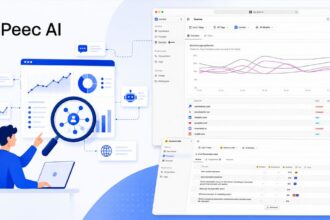
This is where tools such as Profound and Peec AI fit into the workflow. Profound is useful to explore through automated AI search visibility monitoring, especially when the goal is to understand brand presence across AI-generated answers at scale. Peec AI is worth comparing through tracking how your brand appears in AI answers, particularly if you care about recurring answer patterns and competitor visibility.
A simple monitoring workflow
Start with a small prompt set before building a giant dashboard. I usually prefer 20 to 40 prompts grouped by buying intent, use case, competitor comparison, and problem awareness.
For example, a SaaS brand might track prompts around “best tool for,” “alternative to,” “how to solve,” “software for,” and “compare X and Y.” A freelancer could monitor prompts tied to their niche, city, service category, and buyer pain points.
The workflow is straightforward:
- Define the prompts that match real buyer questions.
- Run them across the AI platforms your audience likely uses.
- Record brand mentions, competitors, sentiment, and accuracy.
- Repeat on a fixed schedule, such as weekly or monthly.
- Connect changes to content updates, PR mentions, reviews, or new third-party pages.
The goal is not to obsess over every tiny fluctuation. AI answers move around. No biggie. What matters is whether your brand is becoming more present, more accurately described, and more consistently associated with the right problems.
The role of GEO tracking in localized AI search visibility
Geography matters more than many teams expect.
AI answers can change when the question includes a city, country, language, or regional buying context. “Best CRM for startups in the US” may produce a different set of recommendations than “best CRM for agencies in France.” Even when the model is not explicitly localizing, it may lean on region-specific sources, directories, review platforms, news mentions, or local business data.
For local businesses, GEO tracking can show whether AI assistants mention them for nearby service searches. For multi-national brands, it reveals whether visibility is strong in one market but weak in another.
A localized tracking setup might compare:
| Prompt type | Example focus | Useful for |
|---|---|---|
| City-based | Local service queries | Agencies, clinics |
| Country-based | Regional software options | SaaS, ecommerce |
| Language-based | Native-language prompts | Global brands |
| Market-based | Industry in region | B2B teams |
Localized AI answer monitoring also helps catch awkward gaps. Maybe your English content is strong, but your French or Spanish visibility is thin. Maybe competitors dominate regional comparison pages. Maybe local directories describe your business better than your own site does. That last one stings a little, but it happens.
Strategies for improving and maintaining brand visibility in AI search
Tracking only becomes valuable when it shapes your next move. Once you know where your brand appears, disappears, or gets misrepresented, the improvement work becomes much clearer.
Strengthen the signals AI systems can understand
AI search systems tend to reward clarity. Not always directly, and not always predictably, but clear public information is easier for models to interpret.
Your website should explain who the product is for, what it does, how it compares, what use cases it supports, and which problems it solves. Avoid hiding key positioning inside vague hero copy. “Scale your growth with intelligent solutions” might sound polished, but it gives an AI model almost nothing useful to work with.
Build pages that answer real questions. Publish comparisons, use-case pages, documentation, case studies, pricing explanations, and integration guides. Keep product information consistent across your site, review platforms, profiles, and third-party mentions.
Maintain visibility beyond your own website
AI answer monitoring often reveals that third-party sources influence brand perception heavily. Review sites, directories, listicles, partner pages, YouTube transcripts, community discussions, and public documentation can all shape how your brand is summarized.
That means AI search visibility is not only a content problem. It is also a reputation, distribution, and consistency problem.
A practical maintenance routine could include:
- Update outdated product descriptions across public profiles.
- Encourage detailed customer reviews that mention specific use cases.
- Publish comparison content that explains positioning fairly.
- Fix inaccurate information on high-visibility third-party pages.
- Monitor competitor prompts to spot missing content angles.
The best teams will treat AI search visibility tracking as an ongoing feedback loop. Measure how AI systems describe the brand, improve the public signals feeding those answers, then check again. It is not magic, and it is not traditional SEO with a new label.
It is closer to teaching the web to describe you correctly.
Tracking AI search visibility will not give you perfect control over how models describe your brand. It will give you something more useful: a clearer view of where you stand, what is missing, and which signals need to be strengthened.
For now, the brands that pay attention early have an advantage. Not because they can “hack” AI answers, but because they can notice patterns, fix weak spots, and keep improving how the web explains who they are. What are you seeing when you test your own brand in AI search?

Artificial Intelligence Specialist | AI-Driven Workflow Strategist