
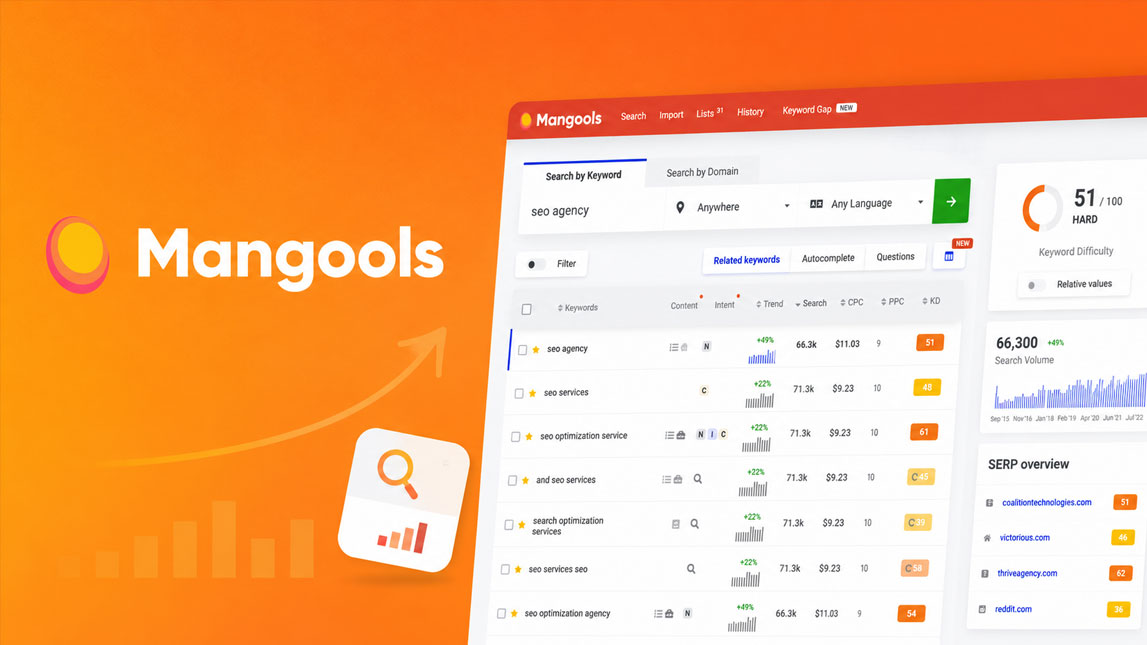
Open an SEO tool for the first time and it can feel like walking into a cockpit. Charts everywhere, scores you do not fully trust yet, and enough filters to make a small business owner quietly close the tab.
That is why Mangools is interesting. It takes the parts of SEO most small businesses actually need, keyword research, rank tracking, and competitor checks, and makes them feel usable without requiring a full-time SEO brain switched on all day.
The SEO challenge for small businesses
Small business SEO often breaks down for normal reasons: limited time, no dedicated specialist, and a budget that already has too many tools fighting for space.
That is why “powerful” is not always the best feature. For many owners, the better question is simpler: can I understand what to do next without spending half a day inside dashboards?
The Mangools SEO tool fits that need well. It gives enough data to make better content and search decisions without burying the user in metrics they will never touch. For a broader comparison, it also connects well with how I would evaluate SEO tools for a small business budget.
Introducing the Mangools SEO tool suite
Mangools is a set of easy SEO tools built around the tasks most small businesses actually use: keyword research, rank tracking, SERP analysis, competitor checks, and backlink insights.
The interface is the main appeal. It feels lighter than many enterprise SEO platforms, which matters when the person using it is also handling sales, client work, invoices, and campaigns.
A typical Mangools workflow might look like this:
- Find realistic keywords with KWFinder.
- Check ranking difficulty and search intent.
- Track important positions with SERPWatcher.
- Review competitors through SiteProfiler.
- Use the findings to improve pages or plan content.
That flow is practical enough for small teams, freelancers, local businesses, and indie SaaS founders who want search visibility without building a full SEO department.
KWFinder: simplifying keyword research for small businesses
Finding keywords you can actually rank for
KWFinder keyword research is probably the strongest reason to look at Mangools for SEO. Instead of presenting keyword data like a spreadsheet from another planet, it shows the essentials: volume, difficulty, related terms, and the pages already ranking.
Small businesses rarely need thousands of keyword ideas. They need a few realistic ones.
For example, a local service business may not be able to compete for a broad keyword like “accounting software” or “marketing agency.” KWFinder makes it easier to spot narrower terms with clearer intent, such as location-based searches, comparison queries, or long-tail phrases customers already use.
Turning keyword data into content decisions
The real value appears when keyword difficulty becomes a filter. A small business owner can skip unrealistic terms and focus on keywords where the SERP looks less intimidating.
Here is a simple way to think about it:
| Need | Mangools feature | Practical outcome |
|---|---|---|
| Content ideas | KWFinder | Better keyword targets |
| Ranking checks | SERPWatcher | Clear progress tracking |
| Competitor research | SiteProfiler | Sharper SEO direction |
No magic button, of course. Just cleaner decisions.
Beyond keywords: tracking and analysis with Mangools
Keyword research only matters if you can see what happens after publishing. SERPWatcher helps track rankings over time, which is useful when updating old pages, testing new blog topics, or checking whether SEO work is moving somewhere.
SiteProfiler adds competitor context by showing authority, backlink patterns, and top-performing content.
This is not about copying competitors. It is about spotting gaps: what they cover, where their authority comes from, and what kind of pages search engines seem to reward.
For small business owners, that level of visibility is often enough to make smarter moves without needing an advanced SEO stack.
Affordable SEO software that delivers value
Affordable SEO software is not just about the lowest monthly price. It is about whether the tool saves enough time and confusion to justify staying in the workflow.
Mangools for small business use makes sense because it focuses on core SEO jobs instead of adding layers of enterprise features. That keeps it approachable for owners who want practical search data, not a second job learning software.
Making SEO easier: why Mangools is a small business essential
The strongest argument for Mangools is not that it does everything. It is that it makes the important parts of SEO feel manageable.
For a small business, that means finding better keywords before writing, checking whether published pages are gaining traction, and understanding competitors without drowning in reports. Those are the tasks that keep SEO moving week after week.
Mangools works best when SEO needs to become lighter, clearer, and easier to repeat. For small business owners, that matters more than having the biggest dashboard in the room.
It will not replace strategy, consistency, or good content, but it can remove a lot of the friction that makes SEO feel harder than it needs to be. And sometimes, that is exactly what keeps the work moving.

Artificial Intelligence Specialist | AI-Driven Workflow Strategist